ONE PONY PRESS
Curated by Dane Cervine
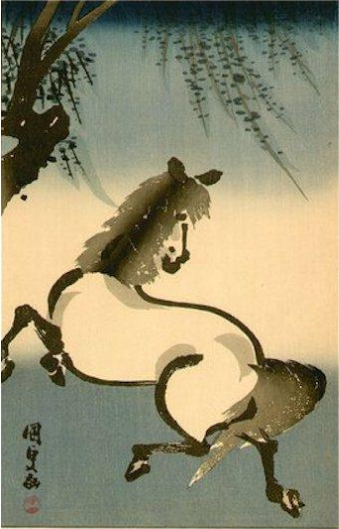
The Japanese artist Aoyama Seizan produced subtle Zen-style horses. Little is known about him except that he was active in the 1920s and 1930s. His work reappeared in the public eye as time passed.
Fittingly, I’ve chosen his solitary horse as a symbol for the simple press I’ve apparently curated over the years under the imprint One Pony Press. It began with the making of small white chapbooks, produced at Kinko’s, for my annual collection of poems. I’d make a cover, my wife would produce handmade invitations with her own collage and art designs, and we’d invite friends and family to our home for a night of poetry, wine, and good conversation.
This lasted for a decade before my poems became books published by a number of marvelous small presses: Plain View Press, Saddle Road Press, Main Street Rag, Word Poetry Press, and the Sixteen Rivers Press collective in Northern California that I am a working member of. Still, as a poet and writer, I find myself drawn to the examples of artists in other fields, where a painter may paint, a photographer make prints, a musician create music to their heart’s content without waiting for “permission” to do so. I make books. So, parallel to work appearing in other small presses, I began to resurrect my earlier imprint One Pony Press, along with a Zen-focused series under the title Kado Press, and make my own books again. They tend to be books unlikely to find a traditional publisher, like family memoir, the aforementioned Zen contemplative series, or experimental writing.
The making of books is a kind of magic. Writers have always managed to get their books made one way or another, though the printing press certainly made things easier than the slow parchment and ink process:
The Gutenberg printing press, invented by Johannes Gutenberg in the mid-15th century, was a revolutionary device that employed movable type, allowing for the mass production of books and other printed materials. This innovation had a profound impact on the dissemination of knowledge, contributing to the Renaissance and Reformation.
While my aim is less lofty than renaissance and reformation, I do like reclaiming the power of the printing press. In this spirit, as I approach the decade of my seventies, my new resolution is to keep making my own books parallel to those published by others. There’s much, apparently, that I want to say before I pass into the intimate obscurity that all writers finally arrive at.
In old Persia, they’d call it a writer’s divân, a testament to poetic legacy, compiling works for posterity and providing readers with a glimpse into their creative mind. Like the book that sits on my desk Odes From The Divan of Hafiz, published in 1903 and purchased as a birthday gift by my daughter from the old Logos Bookstore in Santa Cruz, I am curating a divan in these latter years of life.
New Books

DEEP ORIGINS: At Home in the [Entangled] World
This contemplative travel haibun takes the reader to the green islands of England, Scotland, & Wales. In the year 2000 there was hope we’d begin a better millennium. Now, a quarter century later, the world—and these small isles at the tip (and…

Deep Politics: A Pilgrimage to Krakow, Prague, & Berlin
Deep Politics: A Pilgrimage to Krakow, Prague, & Berlin is a modern haibun of contemplative travel from America, by the poet Dane Cervine. On the heels of his first book of haibun, Deep Travel – At Home in the [Burning] World, he and…

Deep Politics – At Home in the [Divided] World: The First One Hundred Days
Deep Politics – At Home in the [Divided] WorldThe American election of 2024 mesmerized the world. To willingly elect, to choose, again, a president who disdains democracy itself, and wants to be [literally] a king: the shock is still palpable….
Look for the following books at my Amazon author page: DANE CERVINE AUTHOR PAGE
ONE PONY PRESS
Curated by Dane Cervine
FORTHCOMING:
ZEN SERIES:
MEMOIR:
POETICS:
MISCELLANEOUS:
HISTORICAL Chapbooks:
[Made each year at Kinkos; some were integrated later into books with other presses]:
POERTRY BOOKS WITH OTHER PRESSES:
Small Poetry Press (Pleasant Hill, California – Chapbooks)